
Stand close enough to a 115-inch screen showing Tomb Raider: Legacy of Atlantis and you start to feel slightly underdressed for the occasion. The Damocles Room – that infamous ancient Greek chamber of plunging swords that once meant instant death in the 1996 original – is rendered in Unreal Engine 5 with a fidelity so precise you can practically feel the bat guano in the air. It is, without question, one of the most visually arresting things shown at Gamescom 2026.
Crystal Dynamics have been working on Legacy of Atlantis as a modern remake of Lara Croft’s debut adventure, and what they’ve produced so far is technically astonishing. The question is whether everything else matches those visuals – and from the September Gamescom build, the answer is complicated.
A Remake That Aims to Please Everyone – But Might Struggle To
Legacy of Atlantis is positioned as the beating heart of Crystal Dynamics’ new “unified timeline” – a single continuity meant to replace both the original 1996 game and 2007’s Tomb Raider Anniversary, while also acting as a sequel to the Survivor Trilogy (Rise, Shadow, and the 2013 reboot). It’s an ambitious, almost audacious goal, and it requires a great deal of mental gymnastics from anyone who has played across those eras.
Each version of Lara Croft was distinctly shaped by the decade that produced her. The original was winking and camp; Anniversary leaned into exploration and scale; the Survivor Trilogy scrubbed away the glamour for gritty combat realism. Legacy of Atlantis seems to want all of those flavours simultaneously, and the friction is already visible.
Survival mechanics – crafting, foraging, skill trees – are present in this Lara’s story, but they sit awkwardly on a character the game frames as competent and self-assured. If this is meant to be the apex of Lara’s journey, why is she still unlocking basic abilities? Why is she cooking foraged food in the field during what is, essentially, a self-booked archaeological expedition? These aren’t dealbreakers on their own, but they add up to a game that doesn’t always seem sure of its own identity.
The Damocles Room: Same Famous Trap, Very Different Game
Where the demo genuinely shines is in its reimagining of the Damocles Room itself. In the original game, those dangling swords were obstacles – dodge them or die. Legacy of Atlantis flips that logic entirely: the swords are now tools for traversal, dropping on cue when shot from a safe distance and providing platforms for Lara to perch on as she scales the chamber.
It’s a smart design decision, the kind that demonstrates a real understanding of why that room was memorable in the first place. The sense of scale – Lara as a small, athletic figure against an impossibly deep cavern filled with flaking Greek pillars and dusty godrays – is preserved and amplified. The puzzle offers a fixed solution but multiple routes, which feels consistent with the franchise’s best moments.
Lara’s movement in this build is also worth celebrating. She flows through the environment with balletic precision – leaping, flipping, hoisting herself onto ledges with an ease that the Survivor Trilogy, in its quest to feel grounded, largely set aside. The character voiced by Alix Wilton Regan feels alive, and when she’s moving at full speed through an ancient complex it’s genuinely exciting to watch.
Release date: Tomb Raider: Legacy of Atlantis launches 12 February 2027 on PlayStation 5, Xbox Series X/S, PC (Steam) and Nintendo Switch 2.
AI in Development and the Questions That Won’t Go Away
Crystal Dynamics have publicly acknowledged using generative AI in early prototyping. The studio insists that all content in the final game will be human-created or human-refined, but the association is difficult to shake – and, fairly or not, it colours how players look at the game.
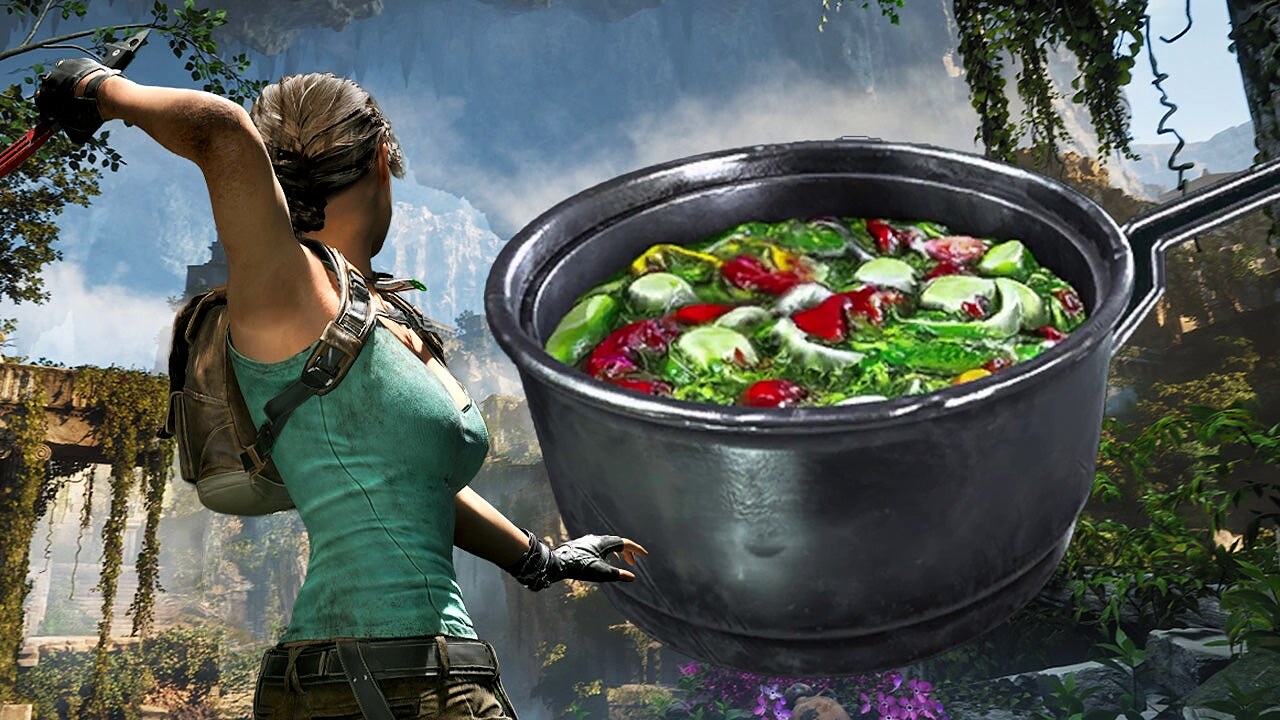
The food crafting menus, visible briefly in the demo, have become a focal point of concern online. Video game food is usually lovingly rendered – think Skyrim’s sweetrolls or Final Fantasy XV’s elaborate camp meals. The dishes on display in Legacy of Atlantis look, charitably, unappetising: mushy stews of indeterminate ingredients that stand at odds with the game’s otherwise extraordinary visual polish. Whether that’s AI-related or simply unfinished is impossible to know for certain, but the association is there, and the studio’s own transparency has made it harder to dismiss.
It’s a lesson for other studios: in a climate where enthusiasm for generative AI is finely balanced with player suspicion, even partial use can define a project’s reputation before it launches.
Still Plenty to Look Forward To
It would be reductive to leave the impression that Legacy of Atlantis is a disappointment – it emphatically isn’t, not yet. What Crystal Dynamics have built is technically extraordinary, and its ambition to honour every era of Tomb Raider is, at minimum, admirable. The Damocles Room alone demonstrates genuine creative intelligence, and Lara’s movement is some of the most joyful traversal the series has produced.
The game is still many months from release, and pre-alpha builds are not final products. The survival mechanics might find their justification in the full narrative. The food menus will presumably look more appealing. The tonal questions might resolve themselves once the full story is in view.
But Legacy of Atlantis has more to prove than most remakes. It carries the weight of an iconic adventure, a unified timeline gamble, and a controversy over AI that it must outrun. Whether it can deliver a coherent experience across all three at once is the real question – and we won’t have an answer until February 2027. In the meantime, Tomb Raider: Catalyst, the separate follow-up from Crystal Dynamics, appears to have slipped to 2028.