
Hide
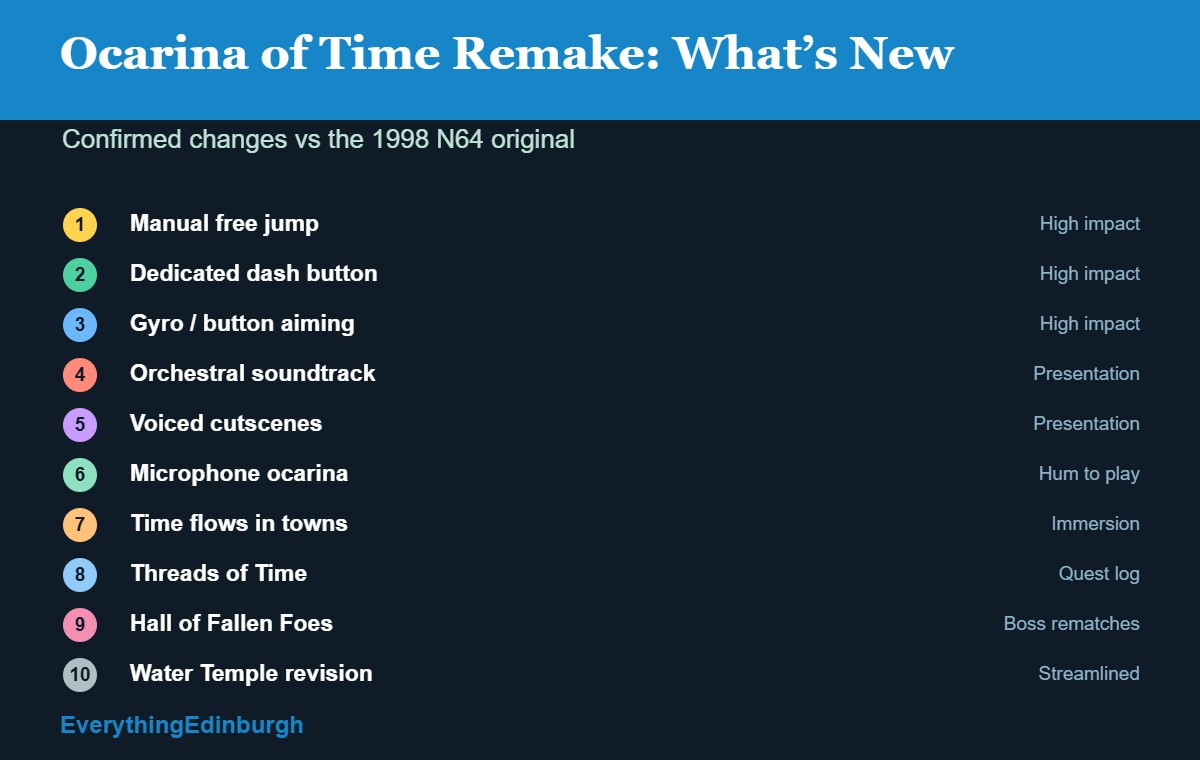
The Ocarina of Time remake (Switch 2, 5 November 2026) keeps the 1998 game’s world and story but rebuilds how it looks, sounds and controls. The headline changes: free manual jumping and a dedicated dash button, gyro or button aiming, a full symphonic orchestral score, voiced cutscenes, an ocarina you can play by humming into the console microphone, time that keeps flowing inside towns, and two new menu features — Threads of Time and the Hall of Fallen Foes — plus the Zelda Notes companion app and another Water Temple revision.
Here is every confirmed difference between the Switch 2 remake and the N64 original, which ones actually change how you play, and what Nintendo has deliberately left untouched. Details are from Nintendo’s “What’s New” trailer and launch coverage (Nintendo Life, Game Rant, VideoGamer), as of 4 November 2026.
Every confirmed change at a glance
The confirmed additions and overhauls, and what each one actually affects in play.
| Change | What it does | Impact |
|---|---|---|
| Manual free jump | Jump on command instead of auto-hopping at ledges | High — changes platforming |
| Dedicated dash button | Sprint without the old bunny-hood workaround | High — faster traversal |
| Gyro / button aiming | Aim bow, slingshot, hookshot by motion or sticks, switchable | High — ranged combat |
| Orchestral soundtrack | Full symphonic re-recording of the score | Medium — presentation |
| Voiced cutscenes | Dialogue now voice-acted | Medium — presentation |
| Microphone ocarina | Sing, hum or play songs via the console mic | Medium — novelty / input |
| Time flows in towns | Day-night no longer freezes in villages | Medium — immersion / sidequests |
| Threads of Time | Combined quest log and visual tapestry menu | Medium — guidance |
| Hall of Fallen Foes | Enemy gallery with boss rematches | Low — post-game extra |
| Water Temple revision | Further streamlining of the dungeon | Medium — one dungeon |
| Zelda Notes app | Companion service via the Nintendo Switch App | Low — optional helper |
The biggest changes in detail
The four changes most likely to alter how the game feels in your hands.
#1
#2
#3
#4
More Zelda on EverythingEdinburgh: our release date & launch time guide, the editions & pre-order breakdown, the dungeon order & beginner tips, and the best Zelda games ranked.
The Water Temple, again
No dungeon in Zelda history is more notorious than Ocarina of Time’s Water Temple, and the remake takes another pass at it. The 2011 3DS version already softened its worst friction — it colour-coded key doors and made the constant pause-menu swaps to the Iron Boots unnecessary by mapping them to an item button. The Switch 2 remake is revisiting the dungeon once more to streamline its water-level puzzles further. The exact changes weren’t fully detailed before launch, so treat the specifics as provisional, but the direction is clear: Nintendo wants the Water Temple to read as a clever puzzle rather than a menu-management chore. If the Water Temple was the reason you bounced off Ocarina of Time decades ago, this is the version most likely to change your mind.
What has not changed
It’s a remake, not a reimagining, and that boundary matters. The remake does not adopt the open-world structure of Breath of the Wild — Hyrule is still the linear, dungeon-by-dungeon adventure from 1998, with the same map, the same story beats and the same progression. Nintendo has not announced new dungeons, a Master Quest mode, or a Hero Mode harder difficulty for the Switch 2 version, so the content footprint matches the original game rather than expanding it. Reviews back this up: NPR calls the remake one of the most faithful adaptations it has seen, “streamlined and safe” rather than radical. The upgrades are presentation and quality-of-life — visuals, audio, controls, guidance — layered onto a game whose design is left deliberately intact. If you wanted a ground-up rethink, this isn’t that; if you wanted the definitive way to play the 1998 classic, it is.
Ocarina of Time remake changes FAQ
Details are as of 4 November 2026, from Nintendo’s “What’s New” trailer and launch coverage (Nintendo Life, Game Rant, VideoGamer, NPR). Water Temple specifics and some feature details were provisional pre-launch; we update as Nintendo confirms more.