
Hide
Final Fantasy Resonance is a turn-based RPG built around one idea: the Stagger gauge. Deplete the meter beneath an enemy’s HP — faster by hitting its weaknesses — and you stagger it, which makes it skip its turn, lowers its defence, and hands you a bonus action. Stagger every enemy in a single turn and you trigger a sweeping stagger, letting your equipped Visions unleash powerful Resonance limit bursts. Everything else — party roles, Visions, Espers — serves that loop.
This guide explains every combat system in Final Fantasy Resonance and how they connect, from the Octopath-style timeline to Espers and Resonances. The combat earned the game a Metacritic 86 for modernising turn-based battles, and understanding the Stagger loop is the difference between grinding and dominating. Mechanics are drawn from the in-game battle system, game8 and the FF Resonance wiki, as of October 2026.
The combat systems at a glance
Every mechanic you’ll use in battle, what it does, and how to make it work for you.
| System | What it does | How to use it |
|---|---|---|
| Timeline turn order | Characters and enemies act in speed order along a timeline | Watch the queue; faster units can act before an enemy recovers |
| Stagger gauge | Meter under enemy HP; emptying it staggers the enemy | Attack it down every fight — it’s the win condition |
| Weakness hits | Take a bigger chunk off the gauge | Match elements/types to each enemy’s weakness |
| Stagger (break) | Enemy skips its turn and takes reduced-defence damage | Dump your hardest hits while it’s broken |
| Bonus action | Staggering an enemy grants an extra action that turn | Use it to pile on damage or set up the next break |
| Visions | Equipped echoes that teach abilities and power Resonances | One per character; bank abilities through wins |
| Sweeping stagger | All enemies staggered in one turn | Spread stagger across targets to break them together |
| Resonance | A Vision’s unique limit burst, unlocked by a sweeping stagger | Chain them for huge AoE burst |
| Espers | Summons Fina calls as a free field unit | Let them act, then fire their signature skill before they leave |
How the Stagger loop works
Every battle in Final Fantasy Resonance follows the same rhythm. First, set up the break: attack the Stagger gauge beneath an enemy’s HP, prioritising its weaknesses because those take a bigger chunk off. Your Breaker (a character on a stagger-focused Vision like Tronn, or Cloud with Stagger Power +20%) accelerates this. Second, cash in the stagger: once the gauge empties, the enemy is staggered — it skips its turn, its defence drops, and the character who landed the break gets a bonus action. This is your window to unload your hardest-hitting abilities while damage is amplified. Third, chase the sweeping stagger: against groups, break every enemy in one turn to trigger Resonances, your Visions’ signature limit bursts. Fail to stagger and enemies take their full turns against you — which is why a Tank (Warrior of Light’s Provoke) and a Healer keep you alive through the setup phase.
The four systems that matter most
The mechanics that decide fights, and how to exploit each.
#1
Setup
Burst
Summon
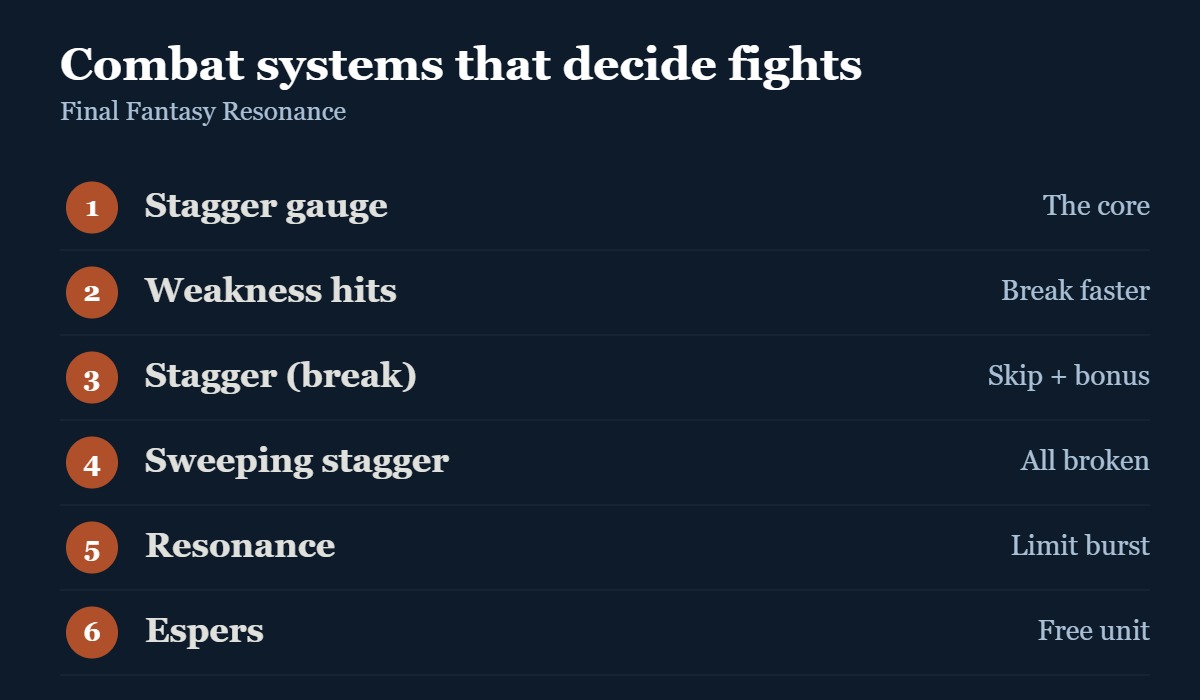
The Stagger gauge is the whole game — treat damage as the reward for breaking, not the objective. Weakness hits are how you break efficiently, which is why a Vision like Sephiroth, with coverage for four elements, is so valuable: one character can exploit almost any enemy’s weakness. Resonance is the ceiling: when you achieve a sweeping stagger, each equipped Vision can fire its unique limit burst, and chaining several wipes a pack instantly. Espers are the wildcard — Fina can summon one in addition to her equipped Vision, and it stays on the field as an uncontrollable extra party member, taking periodic actions before unleashing its signature skill and leaving. Summon early in a tough fight so it gets maximum value before it departs.
More Final Fantasy Resonance: our beginner guide, best Visions tier list and best team composition.
Turn order & the damage window
Battles play out on a timeline (as in Octopath Traveler): units act in speed order, and you can see the upcoming queue. Use it to plan the break — if a fast character can act before an enemy recovers, line up the hit that finishes the Stagger gauge so the enemy is broken before its turn comes up and it never acts.
| Phase | What to do |
|---|---|
| Before the break | Hit weaknesses; let the Breaker chew the gauge |
| On the stagger | Use the bonus action + hardest abilities (defence is down) |
| Group fights | Spread stagger for a sweeping stagger → Resonance |
| Tough fights | Summon an Esper early for maximum free actions |
Common mistakes to avoid
The habits that cost new players fights. Tunnelling one enemy in a group wastes the sweeping-stagger payoff — you break one, kill it slowly, and eat everyone else’s turns; instead spread stagger damage to break the pack together. Ignoring weaknesses means breaking far more slowly, so always probe elements and keep a wide-coverage Vision (Sephiroth) in the team. Running four attackers leaves you with no one to soak enemy turns during the setup phase — keep a Tank and a Healer. And summoning Espers too late wastes their on-field actions; call them at the start of a hard fight so they get the full duration before their signature skill.
Final Fantasy Resonance combat FAQ
Mechanics are drawn from the in-game battle system, game8 and the FF Resonance wiki, as of October 2026 (game released 22 October 2026). Systems may be tuned in future patches — we update this guide as needed.