
“Is Phantom Blade Zero a soulslike?” is one of the most-asked questions about S-GAME’s wuxia action game — usually right next to “is it like Sekiro, Wukong or Dark Souls?” The honest answer is yes and no, and the “no” is the interesting part. It borrows the souls skeleton but moves completely differently. Here’s what it shares, what it changes, how its difficulty modes work, and the combat tips that’ll get you through the first hour.
What it shares with souls games
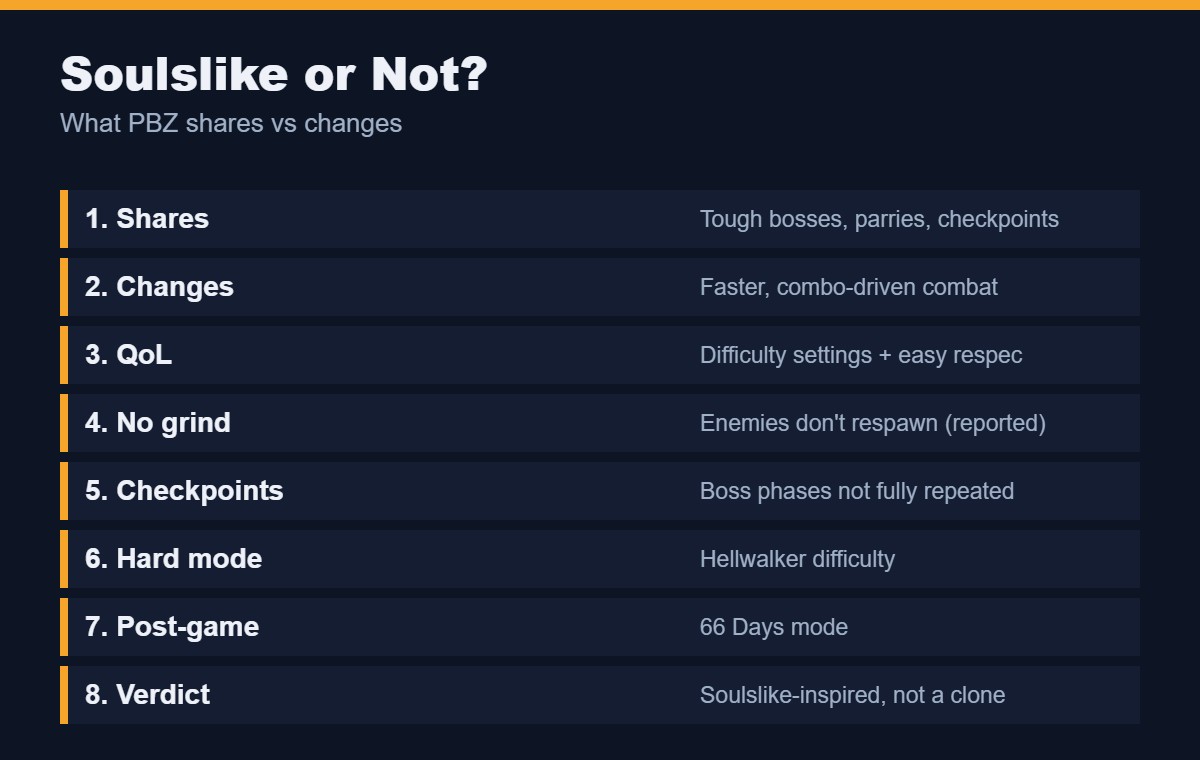
The DNA is real. Phantom Blade Zero takes the parts of the genre that make it tense and rewarding:
| Souls trait | In Phantom Blade Zero |
|---|---|
| Hard, pattern-based bosses | Yes — S-GAME has said there are “at least 50” bosses, and they’re the heart of the game |
| Parry / deflect / dodge defence | Yes — reviewers describe the deflects as “cinematic kung fu” |
| Checkpoints and a resource you can lose | Yes — Sha-Chi fuels guard and heavies; death has weight |
| Exploration of a moody, broken world | Yes — the Wulin / “Phantom World” is grim and atmospheric |
So if you love Souls for the boss duels and the parry timing, you’ll feel at home.
What it does differently
This is where it earns “inspired by” rather than “clone of.” Reviewers were consistent on these points:
| Difference | What it means for you |
|---|---|
| Faster, combo-driven combat | It’s a character-action game first — think long flashy strings, weapon swaps, Phantom Edges, not slow stamina-poking |
| Difficulty settings | You pick how hard it is (Wayfarer, Pathbreaker and up) — a near-heresy in classic Souls |
| Easy, cheap respec | Rebuild freely; no “ruined character” anxiety |
| Enemies don’t respawn (reported) | Clearing an area stays cleared — far less tedium between boss attempts |
| Boss phases aren’t fully repeated (reported) | Dying late in a fight doesn’t always throw you back to phase one |
Those last two — no respawns, forgiving boss checkpoints — are reported by reviews (TheSixthAxis and others). They’re the clearest signal that S-GAME wanted the thrill of souls bosses without the grind around them. PC Gamer summed up the vibe as “feel gud, not git gud.”
Difficulty modes explained
Because you choose your difficulty, the “is it too hard?” question largely answers itself — you set the challenge. The named tiers and modes:
| Mode | What it is |
|---|---|
| Wayfarer | The more approachable difficulty (named in the Nov 3–4 patch, which made boss Hua less grab-heavy here) |
| Pathbreaker | A step up; also covered by the Hua grab nerf |
| Hellwalker | The hard mode for players who want the full souls-style wall |
| 66 Days (post-game) | Unlocks after a first clear — a tougher endgame mode, and the gateway to one exclusive ending |
Practical advice: start on Wayfarer or Pathbreaker, learn the parry timing, and only climb to Hellwalker if you want the classic “git gud” experience. IGN’s reviewer, for scale, spent around 50 hours on the hardest difficulty — a very different game from a Wayfarer run.
First-hour combat tips
These are safe because they’re systemic, not blog “secrets”:
| Tip | Why |
|---|---|
| Treat your two mains as a pair, and swap often | Switching weapons restores Sha-Chi — the swap is a resource engine, not just a style change |
| Learn to parry/deflect before you learn to dodge | Deflection is the core defensive verb; it opens enemies up for your heavy combos |
| Spend Sha-Chi on heavies, but don’t run it dry | You also need it to guard — keep a buffer, then swap to refill |
| Pour early materials into one blade + the skill tree | Spend remnant dust / blackstones on nodes; don’t spread upgrades thin |
| Pick a comfortable difficulty — you can enjoy it on easy | There’s no shame tax; the combat is fun at every setting |
| If PC stutters, clear the shader cache | The Nov 3–4 patch reworked PC startup and shaders; use Steam’s “Browse local files” to clear the cache folder |
For which blades to chase, see our Phantom Blade Zero best weapons tier list.
Who will bounce off it
Be honest with yourself before buying. You’ll love it if you want stylish, fast, parry-heavy boss duels and don’t mind dying to learn patterns. You might bounce if you wanted a slow, methodical, stamina-management Souls game — this is quicker and more aggressive — or if you dislike combo-heavy character-action. Launch reviews also flagged story/localization quirks, camera niggles and some PC performance issues, so if those are dealbreakers, check the latest patches first.
Phantom Blade Zero soulslike FAQ
Based on launch reviews (IGN, PC Gamer, TheSixthAxis and others) and the official Phantom Blade Zero store page, as of November 17, 2026. “No respawn” and boss-checkpoint behaviour are reported by reviewers; difficulty names reflect the Nov 3–4 patch notes. Later patches may change performance and balance — check current notes before repeating launch-era complaints.