
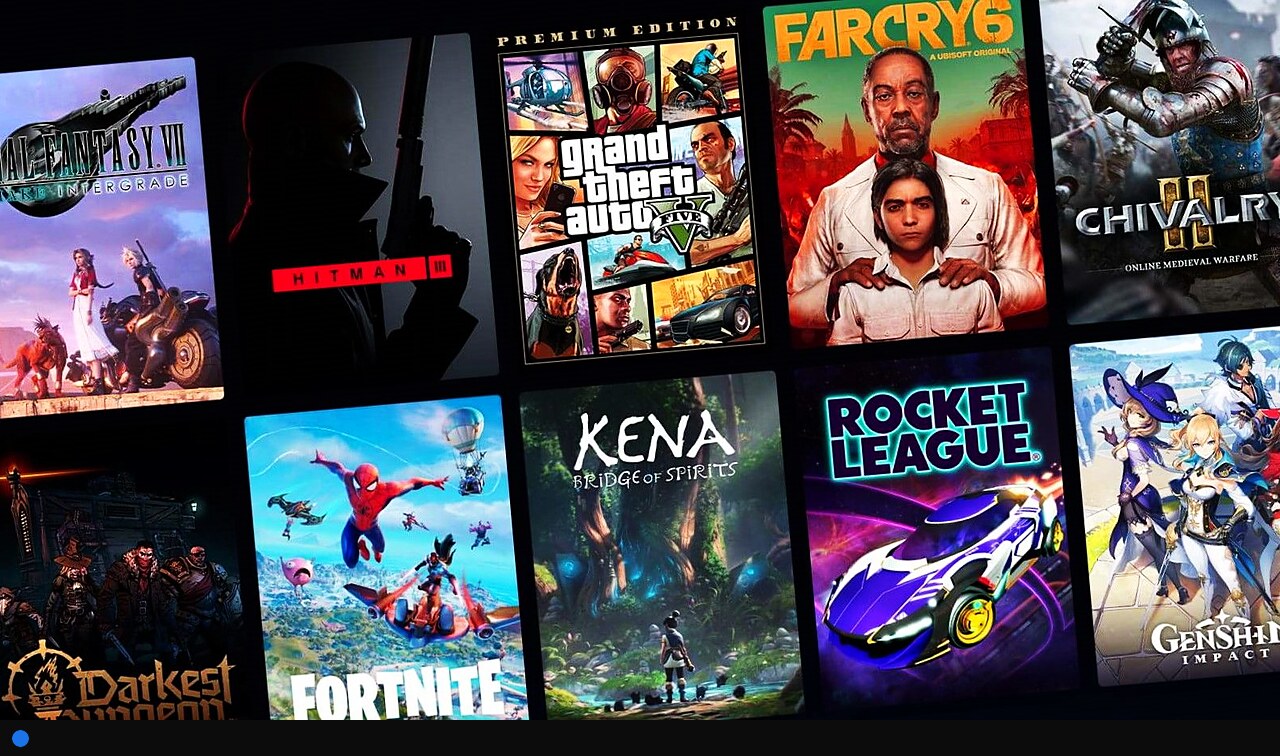
“If you look at the Epic Games Store, I don’t see how they can recover at this point.” That verdict comes from Emmanuel Rosier, director of market intelligence at Newzoo, the industry analytics firm, when asked whether Epic’s storefront can realistically challenge Steam‘s grip on PC gaming. It’s a blunt assessment — and the numbers behind it are difficult to argue with.
The Epic Games Store launched in December 2018, promising to shake up a market that had been Valve’s territory for fifteen years. Nearly eight years on, Epic’s storefront holds roughly 3% of global PC digital game distribution. Steam holds around 74%. The gap has barely moved.
Seven Years and Stuck at 3%
The Epic Games Store has not been standing still. Its store revenue reached $1.16 billion in 2025, a 6% year-on-year rise, with $400 million coming from third-party player spending. It has attracted hundreds of millions of registered accounts and maintained a genuinely developer-friendly 12% commission rate — compared to Steam’s standard 30%.
None of it has shifted the market share needle. Steam sits at an estimated 74% to 75% of global PC digital distribution, a figure that has remained essentially static since Epic launched its assault on the platform. Epic, by its own 2023 court disclosures, had accumulated more than $700 million in losses on the store by that point. The investment, in other words, has been enormous. The market position has not.
Too Many Battles at Once
Rosier’s diagnosis is clear on where the strategy came unstuck. Epic spent years trying to win on multiple fronts simultaneously — against Steam on PC, against Apple on iOS, against Google Play on Android. Each was a significant fight on its own. Running them in parallel spread the company’s focus and resources across too wide a front.
“The challenge I think Epic is facing is that they try to win everywhere in the past few years. They try to win against Steam, they try to win against Apple, against Google Play, and probably they run out of steam on where they cannot fight all these battles at the same time.” — Emmanuel Rosier, Newzoo
The storefront has a new leader now. Martin Keely, who spent seven years overseeing Blizzard’s Battle.net launcher, was named VP and General Manager of Epic Games Store in July 2026. He replaces Steve Allison, who led the store since its launch. Keely is expected to focus on feature parity — adding the community and retention tools that Steam has long offered — rather than further cuts to the commission rate.
Free Games Are a Habit, Not a Hook
The Epic Games Store’s most visible feature has been its free weekly game programme, which has given away hundreds of titles over the years. Rosier’s take on its effectiveness is withering. Players sign in, claim the game, and leave — without building the gaming habits that would bring them back to shop. It’s become a library-building exercise rather than a platform shift.
“The Epic Games Store, they get players by giving free games, but people just go, they log in, they get the free games, they don’t even play them,” Rosier says. “It’s almost like collecting games rather than actually playing them.”
Steam, meanwhile, holds the deeper gravitational pull: years of purchase history, friends lists, achievements, Workshop mods, and a games library that players have no economic incentive to rebuild elsewhere. The switching cost isn’t just inconvenience — it’s the accumulated investment of a gaming life.
Fortnite May Be the Actual Answer
Rosier is more optimistic about Epic’s future as a game developer than as a storefront operator. His recommendation is focus — and specifically, focus on the thing Epic does that no one else can replicate.
“They probably need to focus on what really matters, which I think is Fortnite,” he says. “You can see they are doing a lot with Fortnite now and trying different things. Compared to six months or one year ago, Fortnite is doing much better. I think that’s the path forward.”
As a games platform in its own right — with creator tools, live events, and hundreds of millions of players — Fortnite is something Steam doesn’t have. Whether Epic can use that as a foundation for a different kind of PC gaming ecosystem, rather than a direct store-versus-store fight with Valve, may be the more interesting question for the company’s next chapter.