Review scores for The Sinking City 2 are landing firmly in the positive column this week, with critics giving Ukrainian developer Frogwares the kind of reception that feels genuinely hard-won. GamingTrend awards it 80/100, WCCFTech goes to 8.5/10, GamesRadar calls it a confident survival horror that “can go tentacle to tentacle with modern survival horror like Resident Evil and Silent Hill,” and IGN sums it up in one line that’s hard to improve on: “Resident Evil in a fedora.”
The game is out now on PS5, Xbox Series X/S, and PC, priced at $49.99. If you’ve been watching the Lovecraftian survival horror scene, this is the release to pay attention to this month.

From Detective Game to Survival Horror
Those who remember the original The Sinking City as an open-world detective adventure set in the flooded Massachusetts town of Oakmont should know upfront: the sequel is a fundamentally different game. Frogwares has traded the sprawling, janky investigation maps for something tighter — a structured, chapter-based survival horror experience that wears its Resident Evil inspiration openly and without apology.
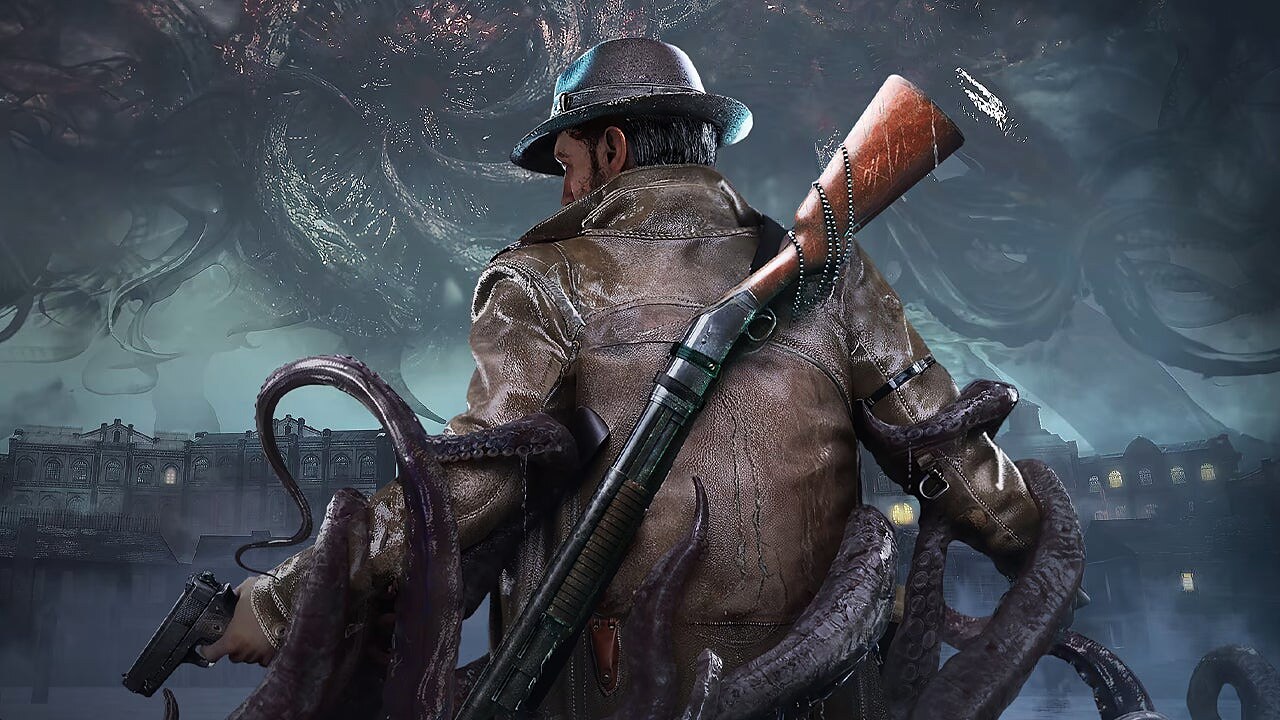
You step into the boots of Calvin Rafferty, an occultist who wakes to find the city of Arkham, Massachusetts being swallowed by an apocalyptic flood in 1929. His partner Faye lies comatose after a botched expedition into Lovecraft’s Dreamlands, and saving her provides the emotional spine of the story. The Cthulhu mythos is packed throughout — Arkham-heads will spot plenty of knowing nods — though the narrative keeps itself followable rather than impenetrably cosmic.
The detective thread hasn’t vanished entirely. A conspiracy-board investigation system lets you gather clues and connect them with red strands to unlock story context and hidden rewards. But the core loop is firmly survival horror: scarce ammo, limited inventory, safe rooms, resource crafting, and combat that punishes overconfidence. IGN notes that Calvin can amass a small arsenal but “there are never enough bullets to kill everything,” keeping tension high throughout.
“This is Resident Evil in a fedora. That might sound dismissive, but I really enjoy the recent Resident Evil games, so it’s much more of a compliment than a put-down.” — IGN
Made Under Fire: The Frogwares Story
No other major release this year carries quite the same weight of context as The Sinking City 2. Frogwares is a studio of roughly 80 people based in Ukraine, and they spent 43 months completing this game through one of the most difficult periods imaginable.
Seventeen team members had their homes destroyed or damaged during Russia’s ongoing invasion. Fourteen have served — or continue to serve — in the Ukrainian armed forces. Power blackouts, heating failures, and the constant presence of the war shaped every day of production. WCCFTech found a quiet Easter egg in the game’s hospital chapter: X-ray images and written stories referencing real people the developers knew, casualties from the conflict. “I’m not ashamed to say I got emotional reading them,” the reviewer wrote.
The fact that The Sinking City 2 is as polished and cohesive as it is — competitive with genre titans on a fraction of their resources — is the kind of thing that makes you put down the controller for a moment and just appreciate it.
Three Chapters Through Arkham, 1929
The game is structured around three main chapters, each set in a distinct location within Arkham. The first moves through flooded city streets and culminates in a creepy, atmosphere-drenched hotel. The second, which multiple reviewers identify as the scariest, is set in an abandoned hospital and introduces a relentless stalker enemy in the mould of Resident Evil 2’s Mr. X. The third takes Calvin into the Arkham Fish Market — which goes about as badly as you’d expect for a Lovecraft protagonist.
Each location is wide rather than open-world, with enough optional rooms and side investigations to reward thorough players. A minimap tracks whether you’ve cleared a room completely, keeping exploration methodical without feeling like busywork. Expect around 13 hours on a first playthrough, with four difficulty settings on offer — including one that enables combat invincibility for those who want the story without the stress.
Where It Falls Short
The critical reception is strong but not unanimous. IGN flags the absence of a sanity mechanic as a missed opportunity for a game so deeply rooted in Lovecraft’s fiction, where reality itself is meant to feel unreliable. Voice performances for Calvin and Faye get a mixed verdict — not wooden, but perhaps too measured for the weight of some scenes. And the narrative takes its time building momentum, with the first chapter moving more slowly than what follows.
Hey Poor Player came in at 3.5/5, arguing the genre shift leaves behind what made the original distinctive — “what used to be a Lovecraftian detective investigation game has turned into a generic survival horror experience.” GamingTrend noted minor technical issues and an inventory system that feels more punishing than it needs to be, with weapons and quest items competing for the same very limited slots.
These are real criticisms. But they sit alongside a near-consensus that the game’s atmosphere, combat pacing, and the remarkable story of how it was made add up to something worth playing. A rune-based perk system and New Game+ unlocks give reason to return — and for a game built in a warzone, that’s a compelling package.