Twelve days. That is how long there is to wait for VHOLUME — a first-person parkour game that looks nothing like any other first-person parkour game, from a three-person studio that includes one of the French developers behind one of 2024’s most critically acclaimed shooters. The combination of pedigree and tonal ambition makes it one of the more quietly anticipated indie releases of the summer.
VHOLUME arrives on Steam on 21 August 2026. It has been in development quietly, and given what the team’s track record suggests, quietly is probably the right approach. A demo is already available to anyone who wants to test the movement system before the full release.

A City Run by Bureaucracy
VHOLUME is set in the derelict capital of Afro-Eurasia, a dystopian city ruled by something called the Ministry. You play as Robert — not a soldier, not a chosen one, not a world-saver. Robert wants his family’s revoked ration tickets restored. That is the entire premise.
“VHOLUME is a melancholic first-person parkour adventure set in a dystopian brutalist city where bureaucracy turns a simple task into an odyssey.”
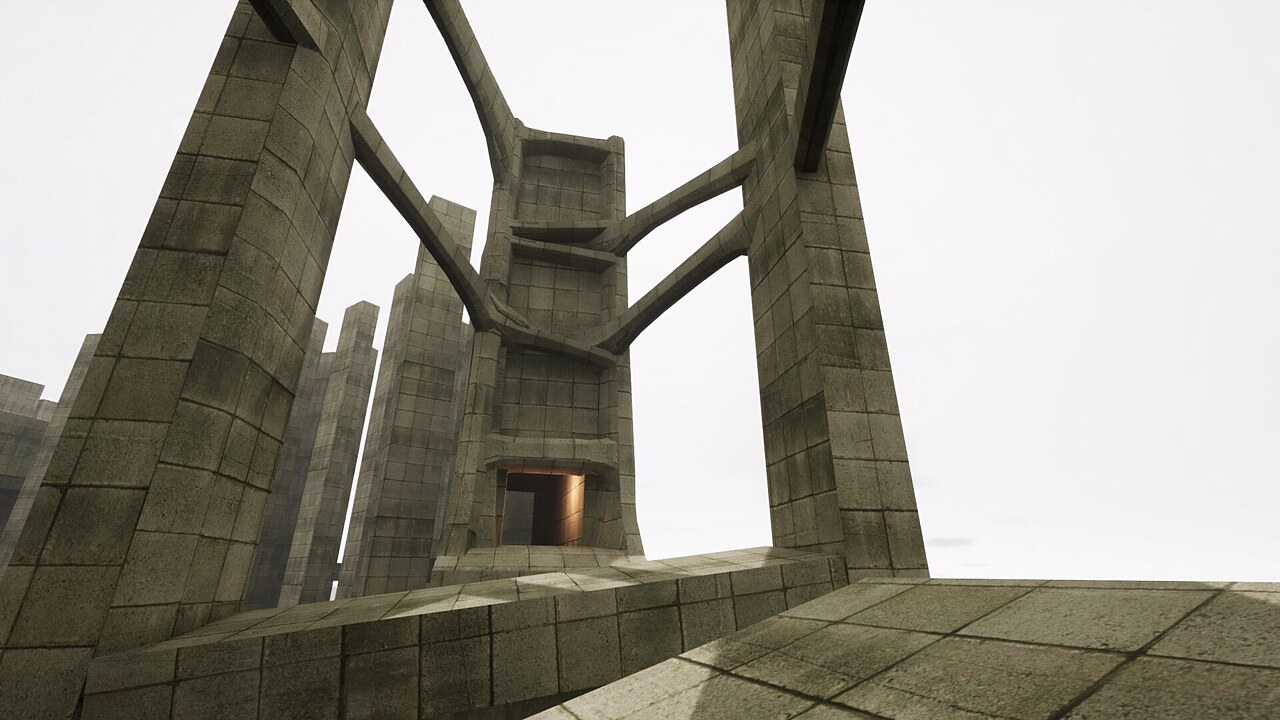
The city itself is the obstacle. Brutalist architecture stretches through overgrown, crumbling spaces that serve both as visual landscape and movement puzzle. The labyrinthine design is intended to be broken — players can discover shortcuts and exploit momentum to beat target times, which gives the game a speedrunning dimension alongside its slower exploratory pace.
It is worth noting what VHOLUME is not. There are no weapons, no enemies to defeat, no combat loop. The threat is entirely systemic — the impenetrable Ministry, the locked doors, the forms that must be filed. Movement is not a tool for violence. It is the only way Robert can push back against a city that was designed to make him feel powerless.
Movement is the core mechanic: jumping, running, climbing, and sliding are all available with considerable freedom. According to the developers, environments are built to challenge both agility and creativity, rewarding players who learn the space rather than those who simply sprint through it.
From Straftat to VHOLUME: A Deliberate Tonal Shift
The connection to Straftat is the most striking thing about VHOLUME’s pedigree. Straftat — the two-player competitive shooter from the Lemaitre brothers — was PC Gamer’s pick for the best FPS of 2024. It is fast, loud, and joyfully violent, a game built around reaction time and aggression.
VHOLUME is the opposite of that. Léonard Lemaitre, one of the Lemaitre brothers and now working alongside Nathan Grange and Niels Tiercelin, has described the game’s atmosphere as melancholic. The soundtrack trades the sharp electronic percussion of competitive shooters for something quieter — ambient sound design built around footsteps and the physical effort of movement. It has been compared in tone to Babbdi, a 2022 exploration game the Lemaitre brothers released before Straftat.
Multiplayer, Ghosts, and a Demo Available Now
Despite the meditative tone, VHOLUME is not strictly a solo experience. Multiplayer lets you race friends through levels in real time or compete against their recorded ghost runs — the same approach used by time trial games to keep competition alive even when schedules don’t align.
The development team is small by any measure: Léonard Lemaitre and Niels Tiercelin serve as core developers, with Nathan Grange rounding out the trio. Publisher IronEqual is handling distribution. Three people is an ambitious headcount for a game with a narrative premise, a full movement system, and multiplayer functionality, but Straftat demonstrated that the Lemaitre approach produces work that punches well above its numbers. Babbdi, the brothers’ earlier game, attracted critical attention for similar reasons: a tiny team, a deeply specific vision, and an atmosphere that stuck with people long after they stopped playing.
Given the game’s pace and atmospheric design, VHOLUME is the kind of project that could find a lasting audience well beyond its opening weekend. There is something appealing about a parkour game that does not glorify movement as power, but instead asks what it feels like to be someone who has no choice but to keep moving. Which is perhaps the most accurate thing you could say about any game that frames an errand as an odyssey.