
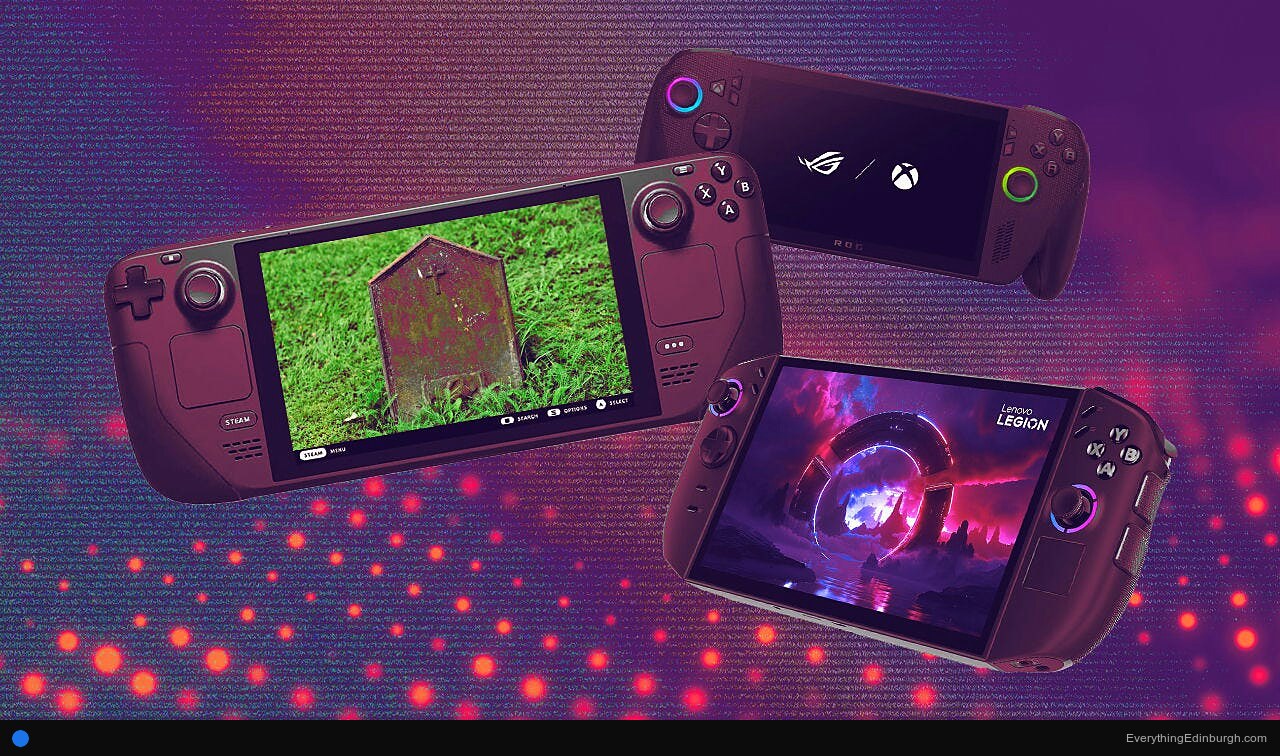
There was a brief, glorious stretch where it felt like handheld gaming PCs had finally arrived. The Steam Deck proved the concept worked. Lenovo and Asus brought serious corporate muscle. Intel launched Panther Lake chips with integrated graphics that could actually play modern titles above minimum settings. For the first time, you could carry a legitimate gaming machine in your rucksack without taking out a second mortgage.
That window is closing. Fast.
The MSI Claw 8 EX AI+ is genuinely brilliant — it outperforms every AMD Ryzen Z2 Extreme handheld on the market — but it costs £1,499/$1,799. The Lenovo Legion Go 2, which actually delivers weaker performance than the Claw, now lists at $1,999 on Best Buy. Even the Steam Deck, the device that started this entire revolution, has seen Valve raise prices by up to $300, pushing the entry point to $789. The golden age of affordable portable PC gaming is on pause, and the culprit has a name: RAM.
The Handhelds That Defined a Generation Are Becoming Unaffordable
To understand how quickly things have deteriorated, consider the price timeline. The original MSI Claw 8 AI+ launched at roughly $899 before creeping upwards through 2025. Its successor, the Claw 8 EX AI+, costs more than double. The Lenovo Legion Go S, praised at an $830 MSRP, now lists at $1,332. The MSI Claw 8 AI+ has become nearly impossible to find below $1,200. And those are the devices that are still available at all.
The Xbox Ally X remains the sole bright spot, holding at $599 for the base model and $999 for the Ally X — though Asus has already raised prices in some regions. Most analysts expect those increases to reach the US eventually.
“At present, the total cost of the product has far exceeded our selling price, even approaching twice the price we originally set.” — AYANEO, on suspending Next 2 preorders
That quote, from boutique maker AYANEO in March 2026, says everything. The company didn’t cancel the Next 2 because it failed. It shelved a finished, desirable product because the bill of materials outran the sticker price. Retroid discontinued the Pocket G2 just five months after launch. The Pocket Classic jumped from $129 to $149. Across the entire handheld gaming market, the pattern is identical: devices with larger memory pools took the biggest hits, while premium configurations were pulled entirely.
AI Ate All the RAM
The root cause is brutally simple. Artificial intelligence data centres are consuming memory faster than the world’s three major fabricators — Samsung, SK Hynix, and Micron — can produce it. These companies have shifted production lines towards high-bandwidth memory (HBM) for AI accelerators, the premium product that OpenAI, Google, and Microsoft will pay extraordinary prices to secure.
The numbers are staggering. According to TrendForce, conventional DRAM contract prices climbed roughly 90 per cent in Q1 2026 alone. Memory, which used to represent 15 to 18 per cent of a PC’s bill of materials, now accounts for closer to 35 per cent. Samsung confirmed that over 60 per cent of its DRAM output in late 2025 went to AI and data centre clients, up from 30 per cent a year prior. OpenAI alone reportedly secured 40 per cent of available global DRAM supply.
For a $600 handheld built on razor-thin margins, this is an extinction-level event. When 32GB of RAM jumps from $150 to over $400, that increase devastates a budget device far more than a £3,000 gaming tower. The maths simply doesn’t work any more.
Boutique Brands First, Big Makers Next
The handheld gaming market spent three years building genuine momentum. Steam Deck proved there was real demand for PC gaming in your pocket. Retroid and AYANEO carved out enthusiast niches. Lenovo and Asus brought corporate credibility. Then the AI industry showed up and ate all the memory.
Boutique manufacturers felt the pain first because they operate on the thinnest margins and smallest production runs. AYANEO’s Strix Halo flagship was pulled entirely. Retroid pulled the 12GB tier of the Pocket 6 from guaranteed shipping. But the crisis is climbing the food chain. Valve’s Steam Deck is now intermittently out of stock across Germany, Austria, Poland, France, Canada, and Japan. Even major brands are rationing what they can ship.
The uncomfortable truth is that gaming hardware prices have grown more expensive across every category — consoles, PCs, and handhelds alike. Nintendo confirmed a Switch 2 price increase from September 2026. Microsoft is expected to do the same. The question is no longer whether prices will rise further, but whether consumers will simply stop buying.
Is There Any Relief in Sight?
The honest answer is: not for a long time. The big three memory manufacturers have reportedly sold through their production capacity for 2027. New fabrication plants — including Micron’s Idaho facility and SK Hynix’s Yongin cluster — won’t reach meaningful volume until late 2027 at the earliest. Counterpoint Research found there is “no scenario where memory prices correct in the second half of 2027.” IDC explicitly stated it does not expect prices to return to 2025 levels within its forecast horizon.
The Phison CEO warned that many consumer electronics manufacturers will “go bankrupt or exit product lines” by the end of 2026. For the handheld gaming market, which operates on thinner margins than consoles or desktop PCs, that timeline could be even more brutal.
The practical takeaway: If you’ve been waiting to buy a specific handheld configuration, the window is narrowing. Prices are not expected to drop this year, and high-RAM models are being discontinued entirely. The device you want at the price you remember may not return.
There’s a cruel irony at work here. Handheld gaming PCs have never been more capable. Intel’s Panther Lake and Arc G3 Extreme chips deliver genuine 1080p gaming. SteamOS is expanding beyond Valve’s own hardware. The software experience has never been better. But none of that matters if the hardware costs twice as much as it should.
The handheld revolution was real. Whether it survives the RAM crisis is another question entirely.