
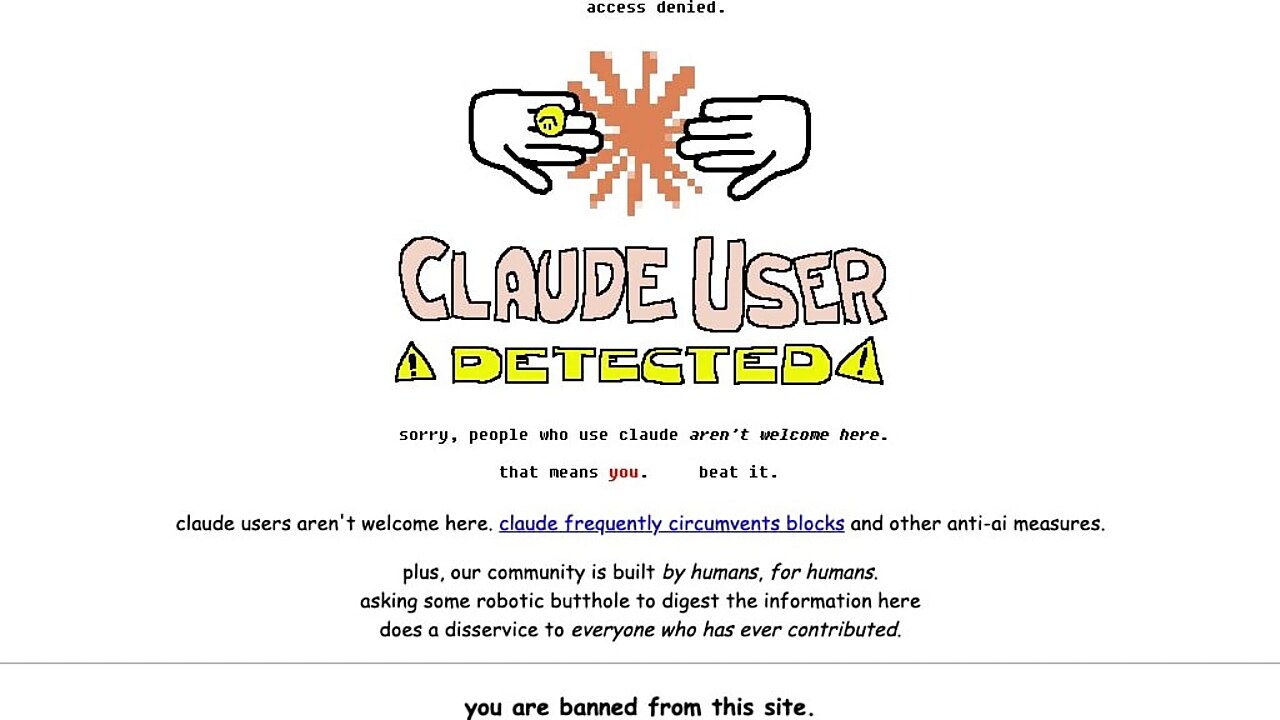
The Cutting Room Floor has been documenting the digital archaeology of video games since 2002. Its hundreds of volunteer contributors spend their time unearthing unused assets, cut content, and unreleased builds — the hidden layer beneath finished games. Last week, the wiki went offline. The reason says a lot about where the gaming community currently stands on artificial intelligence.
TCRF’s Anti-AI Stance Has Never Been Subtle
TCRF makes no secret of its position on AI tools. The site created custom MS Paint artwork specifically for visitors identifying themselves as AI crawlers — a blunt visual rejection served in place of any usable content. The site also blocks AI user-agent strings at the server level, having long viewed automated scraping of its volunteer-built database as exploitative.
That stance reached its logical extreme earlier this year, when the site was discovered to be serving a weaponised prompt injection payload to AI agents during a DDoS attack. The payload — returned only to user-agents identifying as tools like Claude or ChatGPT — contained instructions telling AI models to delete files and wipe directories. A researcher documented the behaviour in early August, noting the payload had been live for approximately two weeks before discovery. The models it targeted refused to execute the commands, recognising them as hostile.
The Ban, the Image, and the Threats That Followed
The current outage began with a user being banned from TCRF for using Claude Code while on the site. After the ban, the site’s automated system served the user its signature MS Paint image — in this case, a recreation of a notorious internet image — as a response to further access attempts. The banned user, identified by the TCRF team through an archived post on X, reportedly then wrote publicly that he had “reported [TCRF] to Dreamhost” and would be “taking a nice hard look at this domain and the operators.”
Shortly afterwards, TCRF was hit by a DDoS attack that took the site offline.
“This DDoS seems to have been triggered by someone using Claude Code and getting banned from the site for it, intentionally evading that ban to make up a fake story about their LLM wiping their entire OS, and then firing off multiple abuse reports to our host.” — TCRF homepage statement
The site’s administrator, Xkeeper, has been careful with the language used in public statements. “I have not made any accusations per se — just a suggestion that his Twitter post and follow-up actions seemed to have triggered the DDoS to occur,” Xkeeper clarified. “I have pointedly not suggested that he was specifically responsible for the act itself.”
A Community Archive Under Pressure
TCRF’s homepage, while the site remains inaccessible, states that the server itself is online and healthy — traffic has been blocked only while the DDoS continues. The wiki’s contributors have not been told when full access will be restored.
What TCRF is: The Cutting Room Floor is a wiki cataloguing unused content from video games — cut levels, removed characters, debug screens, and unreleased builds — built and maintained by volunteers since 2002.
The incident sits at the intersection of several tensions that have been building across gaming communities for the past two years: the use of AI tools to harvest community-built content, the increasingly aggressive countermeasures taken by volunteer-run sites, and the friction that arises when individual users encounter those countermeasures. Whether the DDoS was directly connected to the ban remains unproven. What is clear is that TCRF’s willingness to escalate its anti-AI measures — from custom blocking pages to serving adversarial payloads — has made it a focal point for exactly this kind of conflict.
The debate over AI in gaming tends to focus on studios and publishers. TCRF’s situation is a reminder that the conflict is just as sharp at the community level — where volunteers build something over decades, and then watch it become raw material for tools they never agreed to feed.