
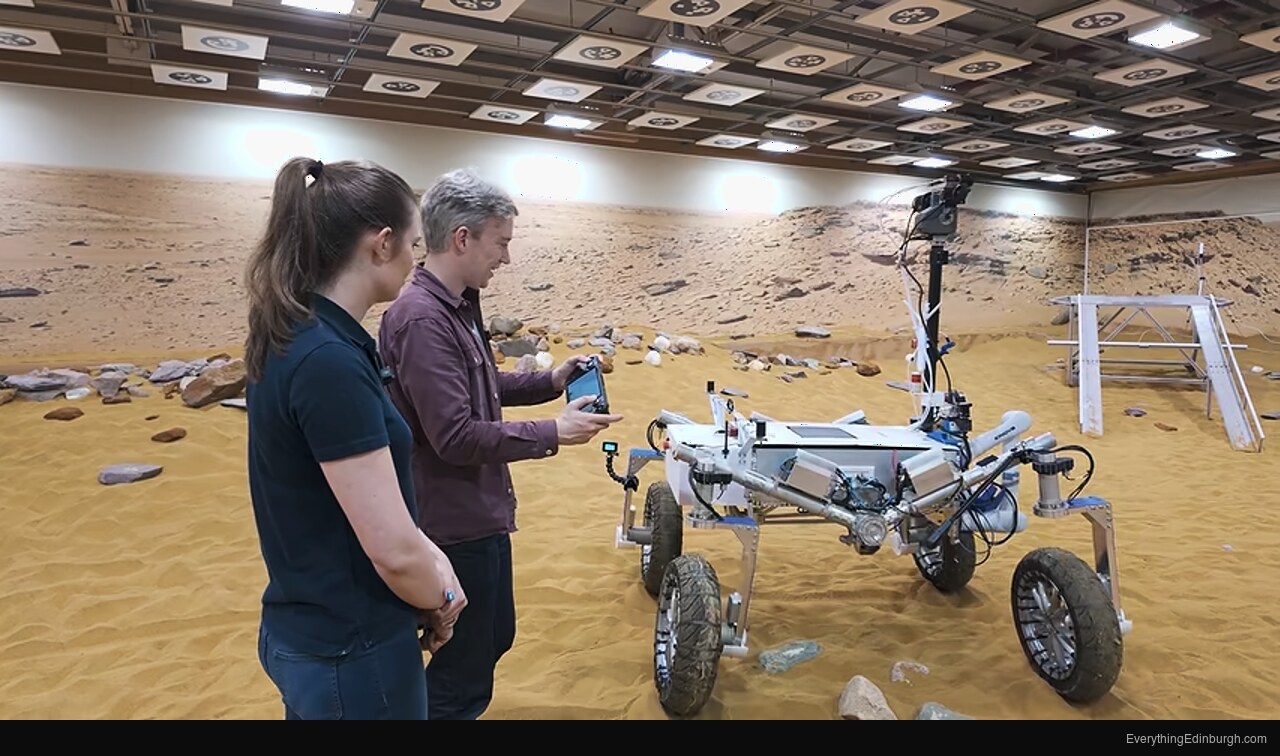
If you were tasked with designing a physical controller to steer a prototype Mars rover around a test facility, what would you actually reach for? Apparently, Airbus’s answer is a Steam Deck — and once you understand the reasoning, it’s hard to argue with them.
The detail emerged from a visit by YouTuber Tom Scott to Airbus’s UK facility in Stevenage, where the team is developing the Rosalind Franklin rover for ESA’s ExoMars mission. In footage from Scott’s visit, an Airbus senior engineer first demonstrates a laptop-based system for issuing discrete movement commands to a prototype. Then Scott himself is handed a Steam Deck — loaded with custom software — and drives a separate rover prototype around the company’s Mars-like test yard in real time.
Why the Steam Deck Makes Sense as a Rover Controller
The Steam Deck is, at its core, a small Linux computer with a built-in screen and a full complement of physical controls: dual analogue sticks, triggers, bumpers, and face buttons. Unlike a conventional gaming controller — a DualSense or an Xbox pad — it doesn’t need a separate computer to run software. You can install what you want on it, directly.
For an engineering test environment, that distinction matters. Custom rover control software can run natively on the device. The handheld becomes a self-contained control station: portable enough to carry across a test yard, robust enough to handle custom applications, and intuitive enough for anyone accustomed to analogue controls to operate without a training course.
The detail: PC Gamer reported that one of the Steam Deck’s bumper buttons is mapped to rotate the prototype rover’s wheels by 90 degrees — allowing the vehicle to change direction without a wide turning circle, particularly useful in tight test-bed conditions.
The laptop, by contrast, handles discrete, command-based navigation: tell the rover to move forward a specific distance, then wait for execution. The Valve handheld handles continuous, analogue steering — the kind of moment-to-moment control that lets a human operator react to terrain in real time. Both approaches have uses; they’re complementary rather than competing.
What Scott’s Visit Actually Shows
In the footage, Scott drives the rover prototype over rocks in the Stevenage test bed — described as a “Mars yard” constructed to replicate the surface conditions of the planet. Its sticks and triggers give him continuous control, translating human input into immediate movement from the machine.
The setup works because Airbus engineers wrote the software. The Steam Deck’s Linux-based operating system makes it receptive to exactly this kind of custom deployment. You’re not jailbreaking it, not fighting the hardware — you’re simply using a versatile PC that happens to come in a handheld form factor, with ergonomic controls designed for exactly the kind of sustained, two-handed interaction that remote vehicle operation requires.
On Mars, Rosalind Franklin Drives Herself
None of this applies once the ExoMars rover reaches Mars. Radio signals between Earth and Mars take anywhere from three to twenty-two minutes to travel in each direction, making real-time joystick control physically impossible. By the time a command arrived from a Steam Deck in Stevenage, the rover would have long since encountered whatever terrain it was supposed to avoid.
The Rosalind Franklin rover is designed for full autonomy on Mars. It uses stereo cameras to map the terrain ahead, plans its own routes from those maps, and receives high-level activity plans via scheduled passes of ESA’s Trace Gas Orbiter. It’s for Earth-based prototype testing only — a convenient tool during development, not part of the rover’s flight systems.
That framing actually makes the story more interesting, not less. Engineering teams routinely improvise practical solutions during prototype development: using off-the-shelf hardware, consumer-grade components, and tools that were built for completely different purposes because they happen to fit the immediate need. It makes a good controller for a Mars rover test because it makes a good controller, full stop. The rest is incidental.
The ExoMars mission is currently targeting a launch window in the late 2020s to early 2030s. Until then, the Rosalind Franklin rover prototype will keep trundling around a test yard in Stevenage — steered, at least occasionally, by a handheld gaming computer that runs Elden Ring equally well.