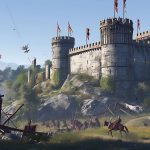
The last proper look at Total War: Warhammer 40,000 was the Gamescom build — the one PC Gamer’s Fraser Brown called the highlight of his year. Since then, Creative Assembly has kept iterating: a friends-and-family playtest, then an “alpha strike” livestream that ran a solid hour and twenty minutes of new campaign footage.
The headline takeaways? Space Marines are brutally hard to replace, liberating Imperial worlds comes with a political cost, and the campaign structure quietly solves one of grand strategy’s oldest problems.
One system at a time
The stream began 23 turns into an Ultramarines campaign with the battle for the Praevoss system — three conquerable planets, plus a gas giant and a dead world that can’t be fought over. Each system gets its own narrative arc, a mini-campaign that plays out before you move on, carrying some but not all of what you’ve built with you.
That soft reset is a smart answer to a familiar complaint: Total War campaigns often go stale once you’ve painted half the map but still have a hundred turns to grind. New theatre, new enemies, fresh tension. Earlier reporting suggests the galaxy layer above it all offers full campaigns, short evening-length campaigns and one-off decisive battles, so players can pick their commitment level before a single drop pod launches.
Liberation has a price
In Praevoss, the Ultramarines’ objective is to liberate Imperial planets from an ork scourge. But the locals don’t simply cheer the transhuman giants marching across their world. When the marines take a region, one option is to “scour the battlefield” — a huge payout in Requisition, at the cost of raised Suspicion.
Calling down fleet bombardment to soften up orks before a battle raises Suspicion too, because civilians are still down there. Oops.
Key point: Playing nice keeps Suspicion down and earns Influence points — the currency for calling up reinforcements from local Imperial troopers. Ruthlessness pays in Requisition but costs you trust.
It’s a faithful slice of 40,000 lore. Imperial planets have their own governments, and history is not kind to visiting chapters — the head of the Astral Claws once hoarded planetary tithes for himself and became the Tyrant of Badab. And, well, there’s the small matter of the Horus Heresy.
Every Space Marine counts
The most striking system shown is attrition. Where other factions replenish losses after battles, Space Marines are severely limited — it takes a decade to train each one, and there are only so many progenoid glands to go around.
Some casualties survive thanks to transhuman physiology, shrugging off wounds that would kill ordinary soldiers. Important characters who fall can be jammed into dreadnoughts and sent back into the fight. But genuine reinforcements have to be called down from the orbiting fleet — and they can arrive mid-battle, via drop pods slamming down right on top of the enemy.
“It takes a decade to train each one after all, and there are only so many progenoid glands to go around.”
Customisation down to the wargear
The Total War: Warhammer trilogy made its name on factions that play completely differently, and that philosophy carries over even to the vanilla Ultramarines. Bespoke wargear loadouts let you outfit units to your preferred style — and the army painter supports custom chapter colours, heraldry and iconography, so your personally cursed teal Ultramarines can look exactly as they do on your painting bench.
Reports from earlier showcases add traits and doctrines on top: lean into shooting, stack speed, or make your defenders even more stubborn. It’s hobby-grade personalisation wired directly into strategy systems — the rare case of a licensed game giving tabletop players exactly what they’ve always wanted, which is an excuse to fuss over colour schemes.
The missing piece: fleet battles
One thing the livestream didn’t show is ship-to-ship combat. Orbital fleets clearly matter — they supply reinforcements, deliver bombardments and ferry armies between planets — but there’s no sign you’ll command them in battle.
Honestly, that’s survivable. If you want 40K naval warfare, Battlefleet Gothic: Armada 2 already exists and is quite good. What Total War: Warhammer 40,000 is building looks far more interesting: a campaign where every marine is precious, every liberation is political, and the galaxy resets just often enough to keep the war fresh.