In Esports Manager 2026 (EM2026) — the CS2-based esports management sim — tactics win matches more than raw star power. The core idea: build a separate plan for each map and each side (CT and T), pick a strategy family — broadly aggressive, control or defensive — that suits your five players’ roles, then read the match in Simulation Mode, reacting to live events as rounds play out. A slightly weaker roster with tactics that fit its players will routinely beat a flashier line-up running setups it can’t execute.
Here is how the tactics system works, how to structure plans by map and side, how to match them to your roster, and how to react live. Mechanics reflect the Simulation module and community guidance, as of 9 November 2026; behaviour is patch-dependent, so treat specifics as a framework rather than fixed numbers.
Strategy families at a glance
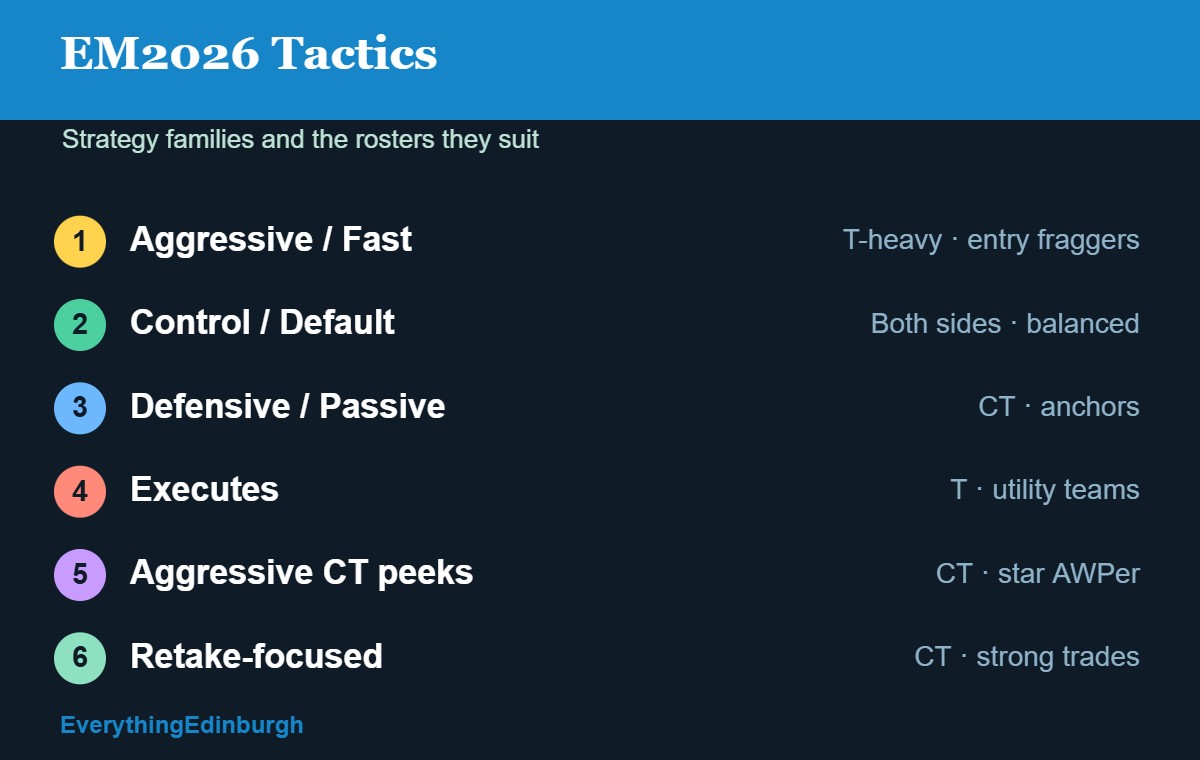
Tactics break into a few broad families. Each suits different player archetypes and situations — think of these as the starting point you then tune per map.
| Family | Best side | Suits players who are | Risk |
|---|---|---|---|
| Aggressive / Fast | T-heavy | Confident entry fraggers, high aim | High — punished if picks fail |
| Control / Default | Both sides | Balanced, map-aware riflers | Low — safe baseline |
| Defensive / Passive | CT-heavy | Patient anchors, good support | Low — cedes map control |
| Executes / Set-pieces | T-heavy | Disciplined, utility-reliant teams | Medium — needs coordination |
| Aggressive CT (peeks) | CT | Strong AWPer, confident duelists | High — info trades for picks |
| Retake-focused | CT | Teams with strong utility & trades | Medium — gives up sites early |
One tactic per map & side
You’re meant to plan per map and per side, not with one blanket strategy. The workflow is straightforward: for each map your team plays, write a T-side plan and a CT-side plan, choosing the strategy family that matches both the map’s layout and your roster. A map like Mirage, Dust2 or Ancient with long sightlines rewards a strong AWPer and patient CT peeks, while a tighter map like Inferno, Nuke or Anubis rewards fast T executes and utility. On T side, decide whether you’re taking map control slowly (control/default), running fast hits (aggressive), or relying on practised executes with utility. On CT side, decide between passive anchoring and retakes, or aggressive peeks and early picks if you have the duelists and AWPer for it. The payoff compounds: opponents adapt to what you show, so distinct, map-specific plans — and a couple of variations within each — keep you from becoming predictable. Start with one solid plan per side per map, then add alternates as you climb and meet teams that have scouted you.
Fit tactics to your players
The single biggest lever is matching the plan to your players’ roles and confidence, not to a theoretical ideal. Players have archetypes — entry fragger, support, lurker, AWPer, in-game leader — and stacking the wrong ones breaks a tactic. Three players whose primary role is aggressive entry will step on each other during a live round; one entry supported by a lurker, a support and a reliable AWPer executes far more cleanly. So before you pick a family, look at who you have: a roster built around a star AWPer — the kind of player orgs like NAVI, Vitality or G2 build around — leans into CT peeks and map control; a team of disciplined riflers in the mould of FaZe, MOUZ or Spirit suits executes and defaults; a volatile, high-aim line-up can run aggressive plans but will be streaky. Also weigh confidence and preferred roles — a player forced into a role they dislike underperforms. The rule of thumb: pick the tactic your five can actually execute, even if a “stronger” style exists on paper.
Reacting in Simulation Mode
Simulation Mode lets you step into the match and control tactics in real time, reacting to dynamic in-game events — so a tactic isn’t a set-and-forget choice, it’s something you steer round to round. The skill is reading the game: if your T-side aggression keeps getting picked off, switch to a slower control plan for a few rounds to reset; if the opponent is stacking one site, call plays to the open side; if your AWPer is on form, lean into the aggressive peeks that let them shine. Watch the economy too — force-buys and eco rounds call for different, lower-risk setups than full buys. Because the module reacts to live events, the managers who do best don’t just set a good pre-match plan; they adjust it as momentum shifts, pulling back when a strategy is being read and pressing when it’s working. Pair sensible pre-match plans per map and side with active in-sim adjustments and you’ll outperform rosters that only set tactics once.
More EM2026 on EverythingEdinburgh: the best value players & transfers guide, how to build your team, and the beginner guide.
Esports Manager 2026 tactics FAQ
Details reflect the Simulation module and community guidance, as of 9 November 2026. Exact tactic behaviour is patch-dependent and some fan sources are unofficial and inconsistent, so specifics here are a framework rather than fixed values — always verify in-game and after updates.