Hide
Building a winning team in Esports Manager 2026 (EM2026) — the CS2 esports management sim — starts with one rule: a line-up is five players covering five jobs, not five stars doing the same thing. Cover the core roles — in-game leader (IGL), AWPer, entry fragger, support and lurker — build chemistry through team-building and training, back it with a coach and analyst, and you’ll beat rosters with bigger names but gaps and role clashes. This is where you make your own setups: your five, your tactics, your staff.
Here is how to build a team — the roles to cover, how to assemble and gel a line-up, the staff and training that lift it, and which org to start with. Mechanics reflect the game’s systems and community guidance, as of 9 November 2026; specifics are patch-dependent.
The five roles you must cover
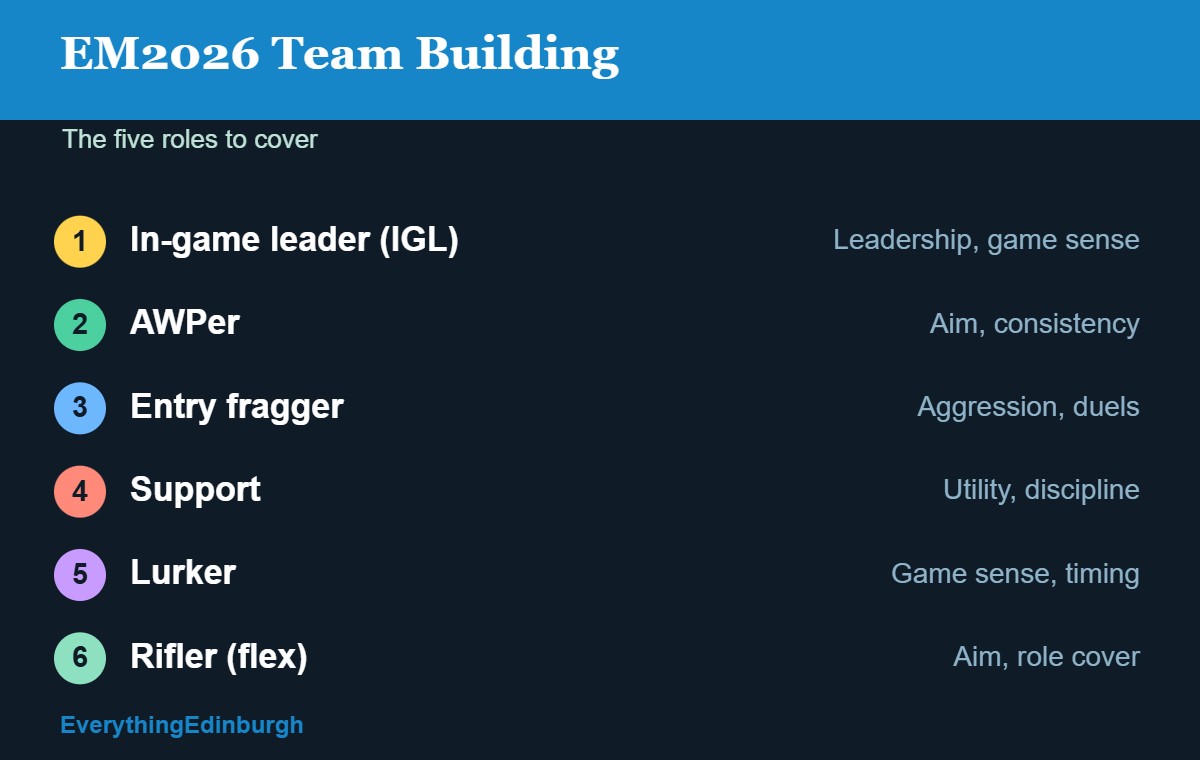
A balanced CS-style line-up needs these jobs filled. Missing one, or doubling up by accident, costs more rounds than a slightly lower rating ever will.
| Role | Job on the server | Prioritise |
|---|---|---|
| In-game leader (IGL) | Calls strategy, mid-round decisions | Leadership, game sense |
| AWPer | Primary sniper, holds angles & picks | Aim, consistency |
| Entry fragger | First into sites, opens rounds | Aggression, duels |
| Support | Utility, trades, sets up the entry | Utility, discipline |
| Lurker | Plays off the team, late-round impact | Game sense, timing |
| Rifler (flex) | General fragging, role cover | Aim, flexibility |
Building your own line-up
Assembling your five is where you build the team your way. Start by auditing what you have: identify which of the five roles are covered and which are gaps, then fill the gaps before upgrading already-solid slots — a missing IGL or support hurts more than a merely good AWPer. When you sign, weigh fit over raw rating: a player who suits your tactics and complements the others adds more than a star who duplicates a role. Keep a stable starting five rather than rotating constantly; consistency builds chemistry. Crucially, don’t expect new signings to gel instantly — run team-building after roster changes so players settle into their roles, and avoid overhauling the whole line-up mid-season. Set your per-map tactics around the five you’ve built (see our tactics guide), so the plan and the players match. Build deliberately — roles first, fit over rating, chemistry over churn — and your custom line-up will punch above its rating.
Staff, training & morale
A line-up is only half the team — you’re also meant to build a full backroom staff and manage your players as people. Early on, prioritise a solid coach (improves training and tactical development) and an analyst (scouting and opponent prep); as you grow, add junior managers, media specialists and more, since every role contributes. On the player side, design weekly training plans that target both skill growth and well-being — performance is explicitly tied to morale, so pure grind without rest backfires. Use team-building sessions, psychology and smart scheduling to keep motivation high, and use the Talk module to understand each player’s needs and resolve issues before they hurt results. Watch your wage structure too: a top-heavy payroll limits future transfers and staff hires. The managers who win treat the roster as athletes to develop, not just numbers — healthy, well-coached players with good morale outperform a stronger five that’s overworked and unhappy.
Which team to start with
You can start from scratch or take over an existing organisation, and for a first save, taking over an established mid-tier team is the gentler learning curve — you inherit a functioning roster and budget rather than building from nothing. Community guides point new managers toward solid mid-table orgs (names like NIP, Eternal Fire, GamerLegion, M80, Heroic or Complexity come up as reasonable starting points), where you have enough resources to compete but room to improve — rather than a powerhouse like NAVI, Vitality, FaZe or G2 with nowhere to climb, or a bottom team with no budget. Whichever you pick, your early jobs are the same: confirm all five roles are covered, fix the most glaring gap, hire a coach and analyst, and set per-map tactics. Starting from scratch is the harder, sandbox-style path — more satisfying once you know the systems, but tougher for a first run. Pick a stable mid-tier org to learn on, get the fundamentals right, and graduate to a from-scratch save once you’ve got the loop down.
More EM2026 on EverythingEdinburgh: the best tactics & simulation guide, the best value players & transfers guide, and the beginner guide.
Esports Manager 2026 team building FAQ
Details reflect the game’s team-building, staff and training systems from the Steam store page and community guidance, as of 9 November 2026. Role names and starting-team suggestions follow community consensus and are patch- and save-dependent — verify against your own save.