
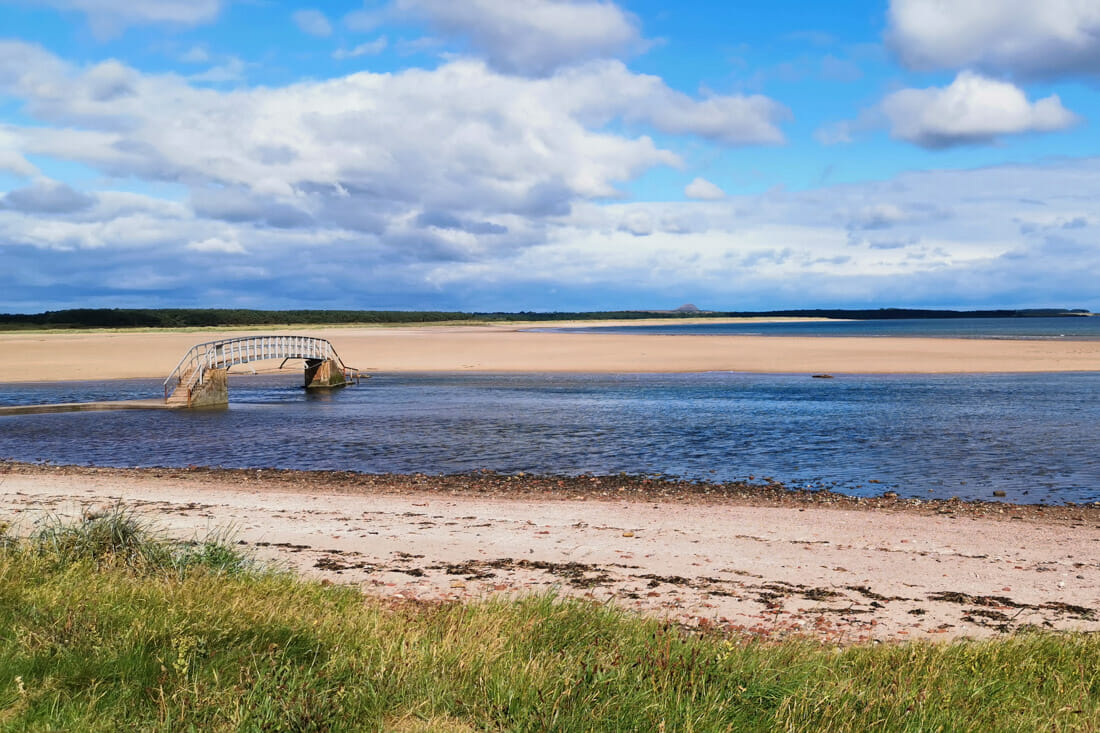
At Belhaven Bay, on the edge of John Muir Country Park, stands one of East Lothian’s most photographed sights: Belhaven Bridge, better known as the “Bridge to Nowhere.”
At low tide it is simply a footbridge over the Biel Water; at high tide the sands flood and the bridge appears to rise straight out of the sea, its steps leading nowhere.
Why “The Bridge to Nowhere”?
The bridge crosses the Biel Water so walkers can reach the beach when the burn is high. Twice a day the incoming tide submerges the sand around it, creating the surreal illusion of a staircase and bridge standing in open water — hence the nickname.
Getting the Photo
Timing is everything. Check a tide table and aim for high tide, ideally around sunrise or sunset for the best light. The Bass Rock sits on the horizon behind it, making a classic composition.
Safety
Never cross or stand on the bridge as the tide comes in — the sands flood quickly and can cut you off. Enjoy it from the beach at a safe distance.
Frequently Asked Questions
When is the best time to see Belhaven Bridge?
At high tide, when the sands flood and the bridge appears to stand in the sea. Sunrise or sunset high tides give the best photos.
Why is it called the Bridge to Nowhere?
At high tide the surrounding sand is underwater, so the bridge and its steps appear to lead nowhere — a well-known optical effect at Belhaven Bay.
Is it safe to walk on the bridge?
Only at low tide. Never use it as the tide rises, as the beach floods fast and you can be cut off.