
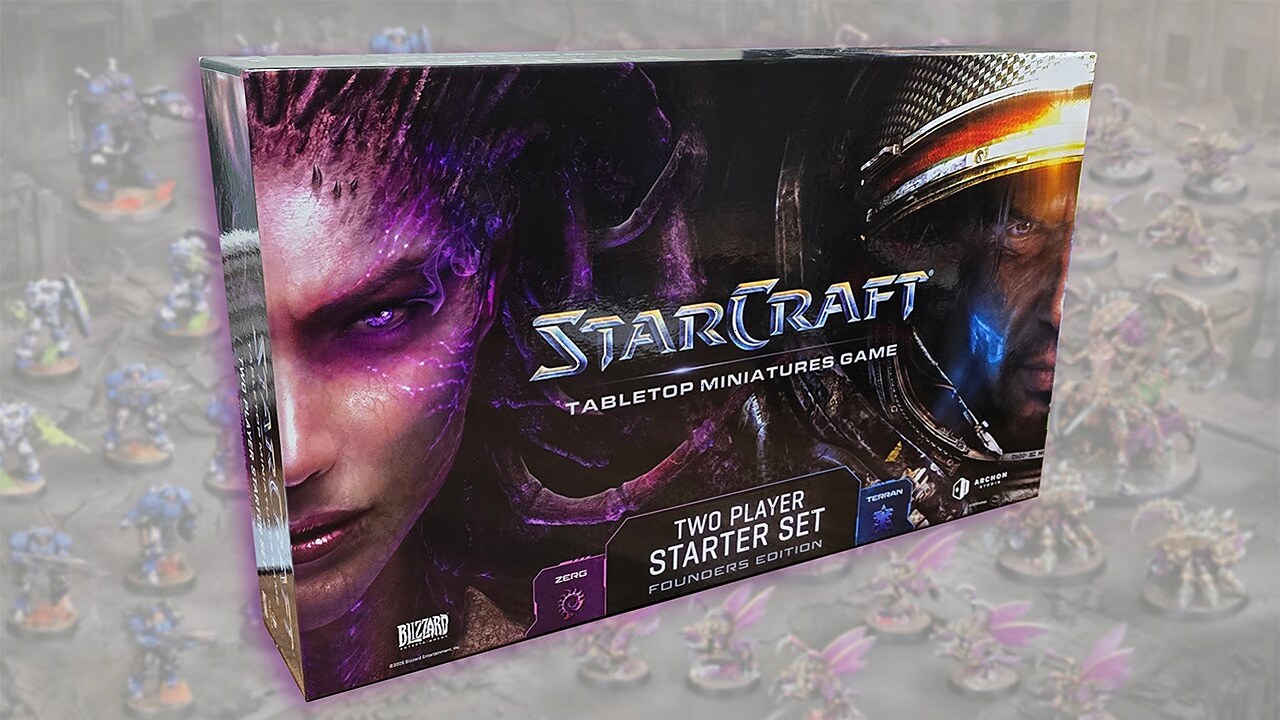
If you’ve ever watched someone spend six hours painting an army only to have the whole afternoon collapse in the first two rounds of Warhammer 40,000, you’ll appreciate what Archon Studio has pulled off with the StarCraft Tabletop Miniatures Game. This is a wargame that understands your time actually has value.
Built in partnership with Blizzard Entertainment, the StarCraft TMG translates one of PC gaming’s most beloved real-time strategy universes into a skirmish-scale tabletop experience. Standard matches run two to three hours — against the half-day or full-day commitment that 40K can demand. That alone is worth raising an eyebrow from anyone who loves miniature wargaming but also has somewhere to be afterwards.
A Wargame That Actually Respects Your Evening
Most of what makes StarCraft TMG feel different from other miniature war games comes down to two core design decisions: alternative activations and a supply limit system.
Instead of watching your opponent manoeuvre an entire army while you sit there mentally rehearsing a strategy you’ll have forgotten by the time it’s your turn, StarCraft operates on alternating activations. Both players take actions back and forth throughout the game, so you’re never more than a few minutes away from doing something. The downtime that plagues 40K — the glazed-eye stretches of waiting — simply doesn’t exist here.
The supply limit adds a second layer of smart design. Rather than deploying everything at once, all units begin in reserve. The battlefield can only hold a set number of troops per round, with that limit increasing as rounds progress. This keeps games manageable, lets strategies evolve mid-match, and prevents a single catastrophic first turn from ruining a three-hour investment. It also captures something faithful to the original PC RTS: you’re building your army as the game develops, not front-loading everything onto the table at once.
Three Factions, Three Completely Different Feels
One of StarCraft’s defining characteristics as an RTS was the radical asymmetry of its three playable races. The tabletop game preserves this faithfully.
Terrans play like a generalist human military — adaptable infantry backed by vehicles, anchored around Marines, Medics, and Marauders. Protoss bring small numbers of individually powerful, psionic warriors: Zealots and Sentries that can punch well above their weight but can’t absorb attrition the way Terran can. Zerg, meanwhile, swarm. Hordes of Zerglings and Roaches designed to overwhelm through sheer volume, led by heroes including Kerrigan.
The miniatures themselves are where Archon Studio has made a statement. Each faction comes in distinctive colour-coded plastic with semi-transparent accent pieces — orange explosion effects for Terran Medics, blue energy shields for Protoss Sentries, pinkish-purple Zerg with sinister organic detailing. Even unpainted, these look compelling on the table. The Pylon miniature includes a clear blue crystal. Archon clearly understood that this IP deserves to be shown off properly.
The Surge Mechanic Makes Combat Click
Combat involves dice — this is a wargame, after all. But the Surge mechanic adds a genuinely clever layer on top of the standard roll-to-hit, roll-to-defend rhythm.
Certain weapons carry a designated Surge type and an associated tag: Light or Armoured. When you attack a unit with the matching tag using that weapon, some of your successful hits bypass the opponent’s armour roll entirely. Suddenly matchups aren’t just about raw probability — you have a meaningful incentive to bring the right counter unit to the right fight. It turns combat into something closer to a rock-paper-scissors layer of strategy without making it feel arbitrary or punishing.
Useful to know: The full StarCraft TMG rulebook is available for free at starcraft-tmg.com, alongside a browser app with all card information. Worth checking before you commit to the Starter Set.
One Concern: The Price and the Long Game
The two-player Starter Set (Terran vs Zerg) runs around $200. Individual army starter sets for Zerg, Protoss, or Terran sit between $120 and $130, with squad and hero boxes coming in at $50–$80 a piece. This is standard wargaming pricing and it is what it is — but it’s a genuine barrier for newcomers who want to try before they buy a full army.
Archon Studio has announced ambitious long-term plans: 40 SKUs per faction across a planned ten-year support window. The lingering question is how the studio keeps the game genuinely exciting once the initial roster is established. New plastic alone won’t sustain a competitive scene, and the tabletop hobby is littered with promising games that lost momentum after a strong launch.
For now, the StarCraft Tabletop Miniatures Game makes a compelling case. It’s tight, it moves fast, the miniatures are excellent, and it offers something the crowded wargaming hobby rarely delivers: a session that fits inside your Saturday afternoon rather than consuming it entirely.