

Hide
Money is the engine of everything in Esports Manager 2026 (EM2026) — the CS2 esports management sim — and the fastest way to grow a budget is to stack several income streams rather than chase one. The big earners: sponsorship deals, tournament prize money, Major sticker revenue, and selling players at peak value, all funded by a healthy, winning organisation. Early on, the priority is staying solvent: enter events you can actually place in, sign cheap, keep wages low, and reinvest winnings — a sustainable org snowballs, an overspent one goes broke.
Here is how to make money: every income source, how to earn early without going bust, trading players for profit, and the spending traps to avoid. Mechanics reflect the game’s business and economy systems and community guidance, as of 9 November 2026; figures are patch- and save-dependent, so this is a method rather than fixed numbers.
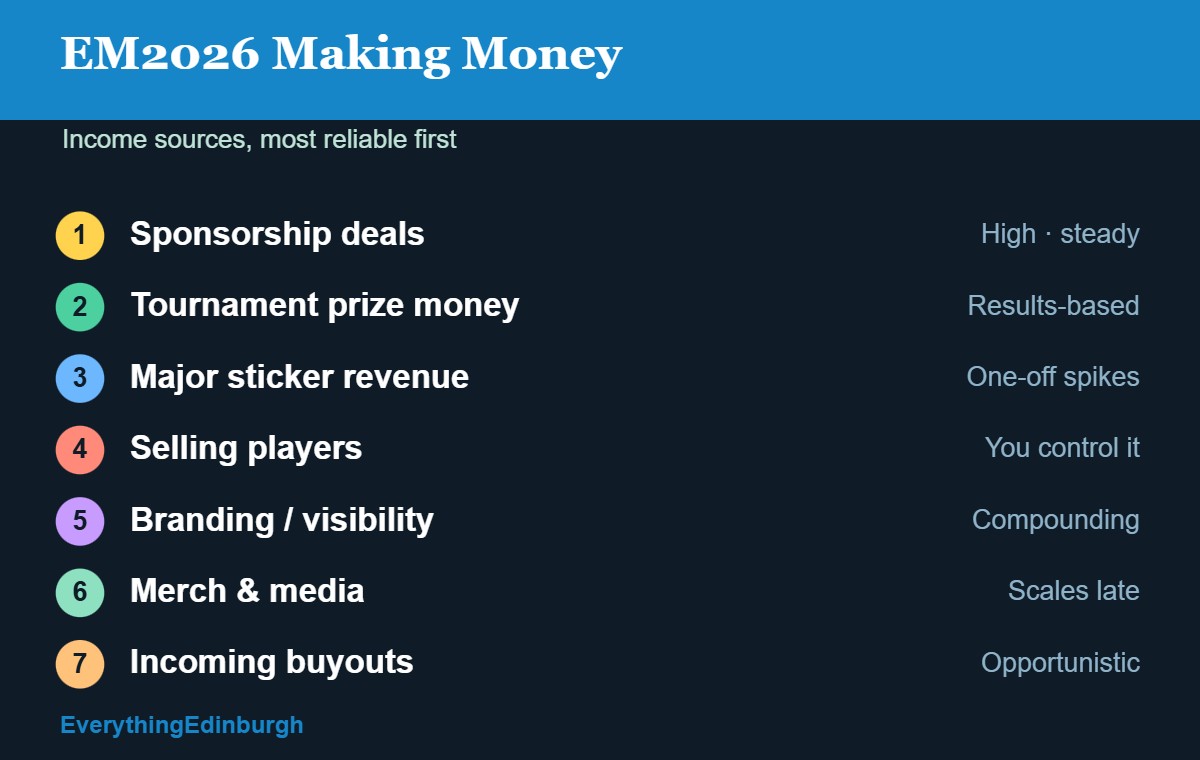
Every income source
The ways your organisation brings in cash, and how reliable each one is.
| Income source | How it works | Reliability |
|---|---|---|
| Sponsorship deals | Signed as your brand/visibility grows | High — steady |
| Tournament prize money | Placing well at events, up to Majors | Medium — results-based |
| Major sticker revenue | Earned by qualifying for/attending a Major | Medium — one-off spikes |
| Selling players | Trade at peak value for a transfer fee | Medium — you control it |
| Branding / visibility | Growing the org unlocks bigger deals | High — compounding |
| Merch & media | Fan base and media reach monetised | Low–medium — scales late |
| Player buyouts (received) | Rivals pay to prise away your stars | Low — opportunistic |
Making money early
The early game is about not going broke while you build toward the big income streams. Keep your wage bill low — a top-heavy payroll is the quickest route to the red — and sign cheap, high-potential players rather than expensive stars you can’t sustain. Enter smaller tournaments you can realistically place in instead of overreaching into Majors you’ll exit early; consistent mid-event prize money beats occasional big-event flops. Lock in whatever sponsorship deals are available for your size, even modest ones, because that steady income smooths the weeks between prize payouts. Reinvest winnings into the areas with the best return — a coach and analyst improve results cheaply, which grows visibility and unlocks bigger sponsors. And watch your weekly balance: if you’re bleeding cash, trim wages or sell a fringe player before the shortfall compounds. Survive the early grind sustainably and the compounding income streams do the heavy lifting later.
Player trading for profit
One of the most controllable income sources is the transfer market itself — buy low, develop, and sell high. The playbook: sign young, high-potential players cheaply, improve them with training and playing time, and sell them at peak value before age or form erodes the price. An ageing star is worth more cashed in now than kept a season too long. You can also profit from incoming buyouts — if a rival overpays for one of your players, taking the fee and reinvesting it in two cheaper signings can strengthen the squad and bank a surplus. Use loans to cover gaps without committing fees, keeping cash free. The discipline that makes this work is the same as value scouting: judge the total cost (fee plus wages) and the resale upside, not just the name. A manager who treats the roster as tradeable assets — developing and flipping talent — always has budget, while one who hoards declining stars slowly goes broke.
Don’t bankrupt yourself
Earning is only half the equation — controlling spending is what keeps you solvent. The number-one killer is a top-heavy wage structure: one or two huge salaries can swallow your weekly income and leave nothing for transfers, staff or emergencies, so cap what any single player takes. Judge every signing by total cost over time, not just the transfer fee — a cheap buy on a massive wage is a trap. Keep a cash buffer for bad runs; prize money is streaky, and a few early exits shouldn’t put you in the red. Don’t over-invest in facilities or staff faster than your income supports them — grow the org at the pace sponsors and winnings allow. And resist panic-selling your best players for a quick injection of cash, because that weakens results and shrinks the sponsorship and prize income that matter more. Spend within a growing budget, keep wages balanced, and the org compounds instead of collapsing.
More EM2026 on EverythingEdinburgh: our best value players & transfers guide, how to build your team, the best tactics guide, and the beginner guide.
Esports Manager 2026 money FAQ
Details reflect EM2026’s business and economy systems (sponsorships, branding, tournaments, player market, Major sticker money) from the Steam store page and community guidance, as of 9 November 2026. In-game figures are patch- and save-dependent, so this is a money-making framework, not fixed amounts — verify against your own save.